
Quick Answer
High summer temperatures speed up the chemical reactions inside golf cart batteries, accelerating water loss, corrosion, sulfation, and self-discharge, which shortens battery life if left unmanaged. You can protect your batteries with shaded storage, regular distilled-water checks, prompt charging, and clean terminals. Glenn’s Golf Cart at 1721 Mentor Avenue in Painesville Township, Ohio serves owners across Lake County and Northeast Ohio with battery inspections, replacements, and expert service.
In this guide
Key Takeaways
The short version
- Heat accelerates evaporation, sulfation, corrosion, and self-discharge, even when the cart sits idle.
- Warning signs include reduced range, longer charge times, terminal corrosion, case swelling, and a sulfur smell.
- Protect batteries by storing in shade, checking water monthly with distilled water, charging promptly, and keeping terminals clean.
- A professional load test is the only reliable way to confirm true battery health, and Glenn’s can perform one.
Why high temperatures are hard on golf cart batteries
Heat is one of the most damaging conditions a golf cart battery faces, and Northeast Ohio summers deliver more of it than people expect. The core problem is that elevated ambient temperatures accelerate the electrochemical activity inside a lead-acid battery even when the cart is sitting idle. That accelerated activity is not producing useful energy. It is producing heat and evaporation, both of which degrade the battery from the inside out.
In a flooded lead-acid battery, which is the most common type found in golf carts, the electrolyte is a liquid solution of water and sulfuric acid. When temperatures rise, that solution loses water through evaporation at a faster rate. If the water level drops below the tops of the battery plates, those plates are exposed to air and begin to sulfate, meaning lead sulfate crystals form on the plate surface and reduce the battery’s ability to accept or hold a charge. Once sulfation becomes significant, no amount of charging fully reverses it.
Heat also speeds up self-discharge, which is the gradual loss of stored energy that happens even when nothing is drawing power from the battery. A battery sitting in a hot garage or left outside in direct sun during a July afternoon in Lake County is losing charge faster than that same battery sitting in a climate-controlled space. Add in the demands of regular summer use and you have a situation where the battery is under constant pressure from both sides.
Lithium iron phosphate batteries, which appear in some newer golf cart models, handle heat somewhat differently than flooded lead-acid batteries, but heat stress is still a real consideration. The Battery Council International notes that heat is consistently among the top factors shortening battery service life across battery chemistries. For golf cart owners in Painesville, Mentor, Willoughby, and the surrounding areas running their carts daily through the summer, understanding this relationship between temperature and battery health is the first step toward getting the longest possible life from the pack.
Signs your battery is struggling in the summer heat
A battery under heat stress usually gives clear signals before it fails completely. Recognizing those signals early can be the difference between a manageable service visit and a full pack replacement.
The most obvious sign is reduced range. If a cart that normally completes a full round of golf or covers your neighborhood loop without issue is now running low before the trip is done, the battery pack is not holding the same charge it once did. Heat-related degradation reduces capacity, and reduced capacity means shorter range per charge. This is not something that corrects itself with a longer charge cycle.
Longer charging times can point to the same problem from a different angle. When batteries lose capacity and efficiency, chargers often run longer to reach the voltage threshold that signals a completed charge. Some chargers stay on for hours past what would normally be expected. If that pattern is new, the batteries are likely the cause.
Physical changes are also worth inspecting. Swelling or bulging on the side of a battery case is a sign of internal heat damage and should be treated as an immediate safety concern. Corrosion around the terminals accelerates in summer heat, and heavy corrosion can restrict current flow in ways that mimic battery failure even when the cells themselves still have capacity. Checking terminals periodically through the season is a simple habit that pays off.
Stop and Get It Checked
An unusual smell during or after charging, sometimes described as a rotten egg or sulfur odor, can indicate that batteries are gassing excessively. Some off-gassing is normal during charging, but a strong or persistent smell suggests overcharging or internal damage. Owners in Kirtland, Chardon, Eastlake, and other surrounding areas who notice this during a summer charge cycle should stop using the cart and have the batteries evaluated before continuing. The team at Glenn’s Golf Cart at 1721 Mentor Avenue, Painesville Township can be reached at (440) 834-5800 to schedule that kind of inspection.
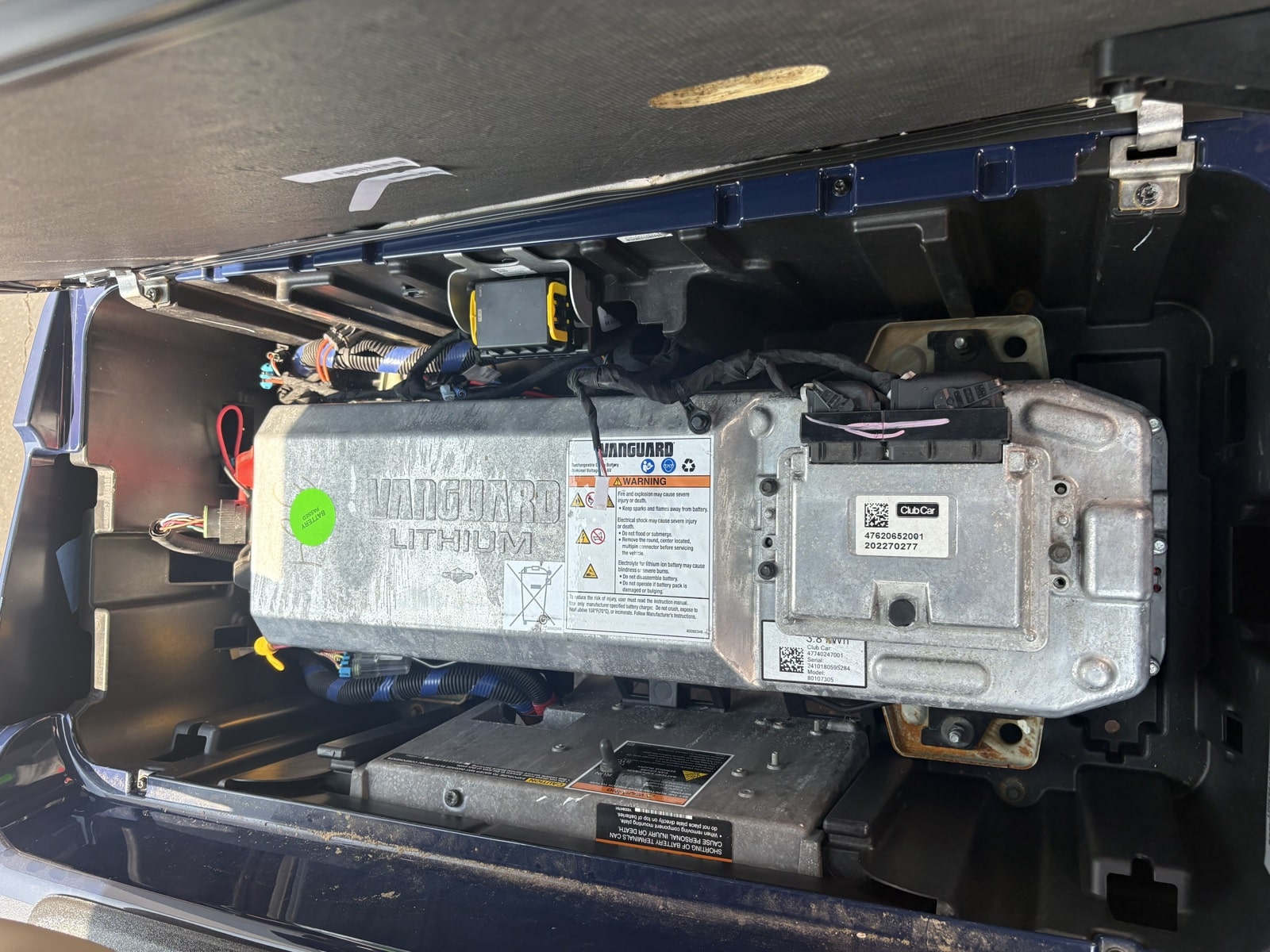
Daily habits that help batteries last through a hot Ohio summer
Golf cart battery care in summer heat does not require expensive equipment or specialized knowledge. Most of what protects a battery pack comes down to consistent habits that take only a few minutes.
Storage location matters more than most owners realize. A cart stored in direct sunlight, particularly on a concrete surface that radiates heat back upward, is sitting in conditions that push battery temperature well above the already warm ambient air. Moving the cart into a shaded area, a garage, or any covered structure significantly reduces the thermal load on the battery. This is especially true during the hottest hours of an Ohio July afternoon.
For flooded lead-acid batteries, checking water levels regularly throughout the summer is essential. The electrolyte in each cell should cover the plates. Distilled water is the correct choice for topping off cells because tap water contains minerals that can contaminate the electrolyte over time. The Electric Power Research Institute has long emphasized proper water maintenance as a key factor in extending flooded battery service life. Glenn’s Golf Cart carries a range of electric golf carts from Club Car, E-Z-GO, and MadJax, and the service team can walk owners through proper watering technique during any visit.
Charging behavior also plays a role in summer battery care. Allowing a battery to sit in a deeply discharged state in hot weather accelerates sulfation. Charging promptly after use, rather than leaving a depleted pack sitting overnight or over a weekend, reduces that risk. Equally, charging in a well-ventilated area matters both for safety and for keeping the battery temperature from rising further during the charge cycle itself.
Terminal maintenance is simple and effective. Keeping terminals clean and free of corrosion ensures that the full available current moves efficiently through the connections. A buildup of corrosion acts as resistance, which creates heat, which compounds the very problem you are trying to manage. This is a check that takes two minutes and can prevent larger problems down the road.
When to visit Glenn’s Golf Cart for a battery inspection or replacement
Some battery issues can be managed at home, but others require hands-on evaluation to diagnose accurately. The challenge with golf cart batteries is that surface-level observations do not always reveal the true state of the cells. A battery that charges to the right voltage may still have significantly reduced capacity, and the only way to confirm that is with a proper load test.
If a cart has been showing range problems, extended charge times, or physical signs of battery stress and those issues have persisted through basic maintenance, that is the right moment to bring it in. Trying to run a degraded pack through a second summer often results in a more expensive outcome because a struggling battery puts additional strain on the charger and the electrical system as a whole.
Replacement timing is also worth considering proactively. Battery packs in golf carts that see regular seasonal use have a finite service life, and knowing where a pack stands before it fails completely allows owners to plan the expense rather than react to it. Heading into the 2026 season, many owners across Lake County and Northeast Ohio who purchased their carts or replaced their batteries several years ago are approaching that evaluation window.
Glenn’s Golf Cart at 1721 Mentor Avenue in Painesville Township, Ohio 44077 stocks both new and used golf carts including electric models from Club Car, E-Z-GO, MadJax, and LSV brands like Icon, Epic, and Sierra. The team services what they sell and can evaluate battery condition for carts already in the field. Calling (440) 834-5800 during Monday through Friday hours between 10 AM and 6 PM is the fastest way to get on the schedule. Saturday appointments are also available for owners who cannot make a weekday work, which is something worth asking about when you call.
For buyers in Mentor, Wickliffe, Painesville, or anywhere in Lake County who are searching for a used electric golf cart near me and wondering whether a particular cart’s battery pack still has real life in it, Glenn’s Golf Cart can help with that evaluation before purchase. Buying a used electric cart without understanding the battery condition is a common mistake, and it is one that the team at Glenn’s is well-positioned to help shoppers avoid. The golf cart on the turntable out front makes the location easy to spot when you turn onto Mentor Avenue.
Frequently asked questions
How does summer heat specifically damage golf cart batteries?
Heat accelerates water evaporation inside flooded lead-acid batteries, which exposes the internal plates and leads to sulfation. It also increases the rate of self-discharge, so batteries lose stored energy faster even when the cart is not in use. Over a full Ohio summer of regular use, this cumulative stress shortens the usable life of a battery pack. Glenn’s Golf Cart in Painesville Township services electric golf carts from Club Car, E-Z-GO, and MadJax and can evaluate battery condition for owners concerned about summer heat damage.
How often should I check the water level in my golf cart batteries during summer?
Check the water level at least once a month during heavy summer use, more often than you would in cooler months, because evaporation rates increase with temperature. Always use distilled water to top off the cells, and add water only after charging rather than before, so you do not overfill a battery that expands slightly during the charge cycle. If you are unsure of the correct procedure for your battery type, the team at Glenn’s Golf Cart at (440) 834-5800 can walk you through it.
Can a golf cart battery recover from summer heat damage?
In most cases, no. Significant sulfation or plate damage from prolonged heat exposure is generally not reversible. Minor heat stress, such as a short period of low water or an occasional deep discharge, can sometimes be partially addressed with proper maintenance and reconditioning. If a battery pack has run compromised through a full summer without attention, the practical outcome is usually replacement rather than recovery. Glenn’s Golf Cart serves owners throughout Lake County and can assess whether a pack is worth servicing or has reached the end of its useful life.
Where should I store my golf cart during hot summer days to protect the batteries?
Store it in covered shade away from direct sunlight, such as a garage or shaded structure, which keeps the cart and battery pack cooler than an exposed driveway or parking area. Concrete surfaces in direct sun radiate significant heat upward into the battery compartment, adding thermal stress beyond the air temperature alone. This matters especially for owners in Painesville, Mentor, Willoughby, and other Lake County communities where summer afternoons get hot enough to affect battery health.
How do I know if my golf cart batteries need to be replaced before the end of summer?
Watch for reduced range that does not improve after a full charge, charging sessions that run significantly longer than normal, visible swelling on battery cases, heavy terminal corrosion, or a persistent sulfur smell during charging, all of which signal that a pack needs professional evaluation. Glenn’s Golf Cart at 1721 Mentor Avenue in Painesville Township, Ohio is open Monday through Friday from 10 AM to 6 PM and offers Saturday appointments for those who cannot make a weekday visit. Calling (440) 834-5800 is the quickest way to schedule a battery inspection and get a clear answer on whether replacement is the right move.
Battery acting up this summer?
Bring it to 1721 Mentor Avenue, Painesville Township, Ohio 44077. A load test is the only way to know what a pack has left. Monday through Friday, 10 AM to 6 PM — Saturday by appointment. Look for the golf cart on the turntable out front.